THE HUMAN BRAIN
The human brain is the most complicated, functioning instrument known to man. Unlike other vital organs, the enormous potential of the brain continues to surprise the scientific community, and thus, it should be understood as the most dynamic of all the organs.
T.N. Wiesel (Winner of the Nobel Prize in 1981) confimed that the scientifc community is aware of approximately 25 percent of the functions of the brain, but stated that this figure is merely an estimation. Thus, according to Wiesel, “No one knows yet where the end to the brain´s workings will take us.” The end is yet to be discovered. The brain is the organ that has the greatest impact on what one can experience, or on the the length of one’s life, thanks to the constant neural connections and the creation of neurons that occurs as a response to diverse stimuli. Each neuron is connected to hundreds or thousands of other neurons. Together, these neurons form extremely complex networks. Our memory, speech, thoughts, movements, and absolutely every function of our mind – personality, behavior, moods, feelings, motivations, etc – depend on these connections. These extremely important connections are known as synapses, and they are developed and modified throughout the duration of one’s life in accordance with their learning and individual experiences.
It is very important not to be careless with regards to the aformentioned pieces of one’s mental development, especially during childhood and adolescence, as this is when the majority of connections occur, when the brain is still developing, and when it is easiest for absorbtion of knowledge to occur. Despite these facts, it is important to note that the adult brain works with the highest efficiency and consciousness at the time it acquires new knowledge. Thus, it is never too late to learn.
The human brain can store enough information to fill some twenty thousand volumes, much like some of the largest libraries in the world, and is equipped with a potential considerably greater than any person could realize in one lifetime.
THE BRAIN IN ACTION: The Talent and Potential of Each Individual
Specialists agree that it is very important to correctly stimulate children’s brains from an early age, in order to achieve optimum development of abilites and form a solid foundation, so that the child may enter the adult world with many advantages over their peers. Thus, the most advisable way in which to correctly stimulate a child’s brain is to put useful tools, such as foreign languages, within their reach. It has been shown that children who begin with a bilingual base acquire their third language with greater ease.
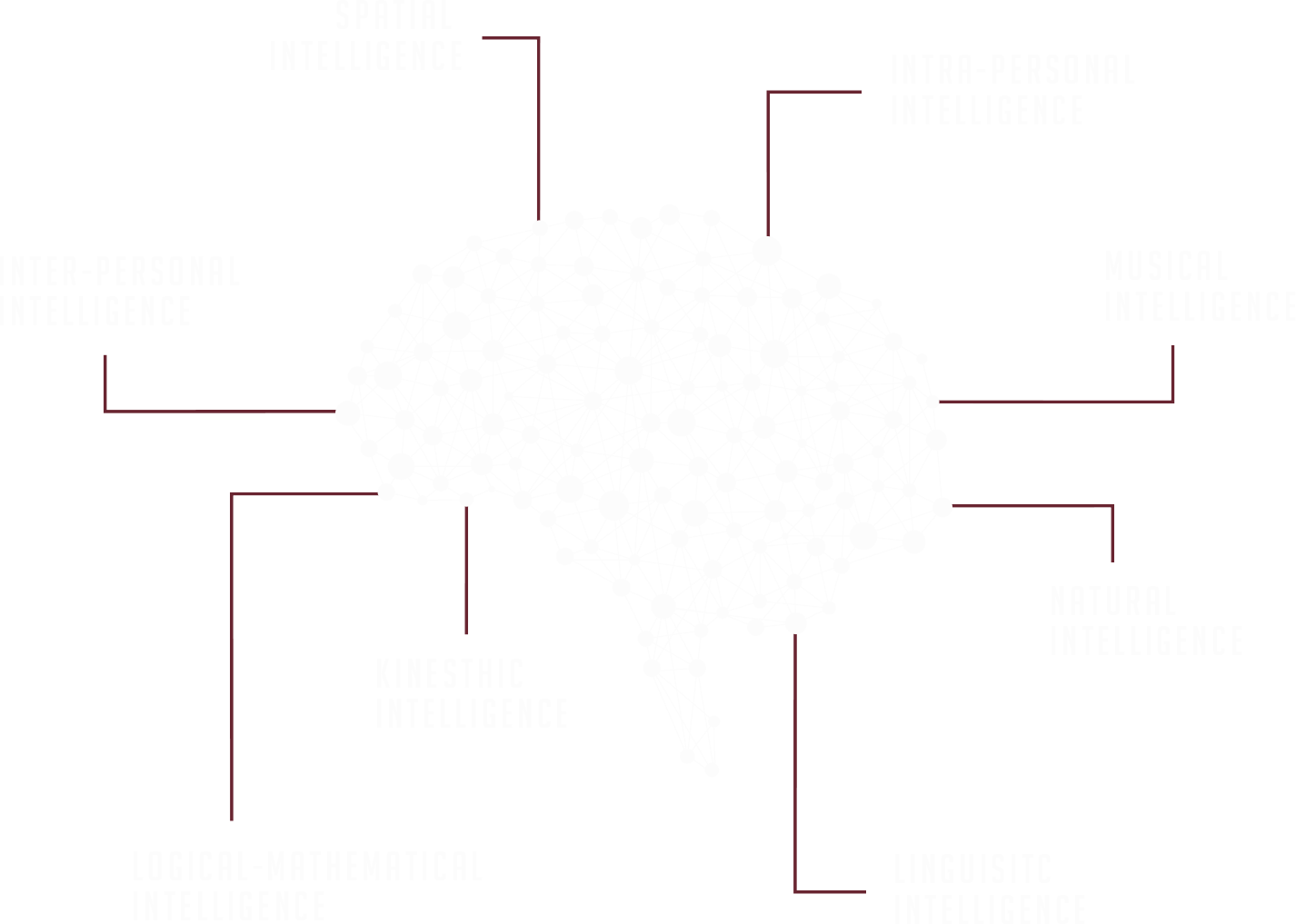
The potential, or talent, of each child is different, and is tied to their genetic coding, but without the correct stimulation, they can never reach their full potential. H. Gardner, recognized researcher at Harvard University, stated within his Theory of Multiple Intelligences (1983) that a person’s inteligence should not be seen as a single unit, but as the combination of multiple, independent, and unique, intelligences.
Secondly, and no less important than his first point, Gardner defined intelligence as a potential. Not too long ago, intelligence was considered to be something innate and immobile. One was either born with or without intelligence, and education could not change this facet of one’s being. This concept of intelligence was so highly valued in society that, until recently, those with psychological disabilities were not educated, because it was considered a pointless undertaking. Fortunately, society considers other psycho-padagogical perspectives. These such perspectives are those that have made it possible for those with Down Syndrome to complete a university degree.
LINGUISTIC INTELLIGENCE
The intelligence that writers, poets, journalists, broadcasters, and speakers possess. It deals with expression through language: either written or spoken.
MUSICAL INTELLIGENCE
Necessary to understand and manipulate sounds. Enables the development of musicians, composers, singers, and DJ’s.
LOGICAL-MATHEMATICAL INTELLIGENCE
This intelligence is used to solve problems. It is the intelligence that scientists, mathmaticians, engineers, and economists have. It corresponds to one’s ability to rationalize, and it is this intelligence that Western culture considered the only form of intelligence for decades.
SPATIAL INTELLIGENCE
Useful to those who can form mental models of spaces, or of the world, in two or three dimensions. It is essential in the work of engineers, surgeons, pilots, astronomers, sailors, sculptors, photographers, designers, architects and decorators.
KINESTHIC INTELLIGENCE
Requires the ability to utilize one’s own body to complete activities or solve problems. This type of intelligence is found most often in athletes, chefs, actors, dancers, chiropractors, and visual artists.
INTER-PERSONAL INTELLIGENCE
This refers to one’s ability to understand, and collaborate with, other people. This intelligence is necessary for those inpublic relations, lawyers, teachers, psychologists, doctors, priests, and leaders of large groups or populations.
INTRA-PERSONAL INTELLIGENCE
Allows one to understand themselves and make changes within themselves. It is the ability to control one’s own thoughts, and to evaluate one’s own personality traits: both those that serve them well, and those that serve to disadvantage them. This type of intelligence is essential in order to meditate, exhibit personal discipline, keep one’s own composure, and present the best sides of oneself. Such traits can be applied in jobs like diplomacy or human resources.
NATURAL INTELLIGENCE
This type of intelligence is used when one observes or studies the environment and understands how flora and fauna work within it. It is also used in biological sciences and in nature conservation. Natural Intelligence is found in ecologists, biologists, geologists, and animal behavioralists.
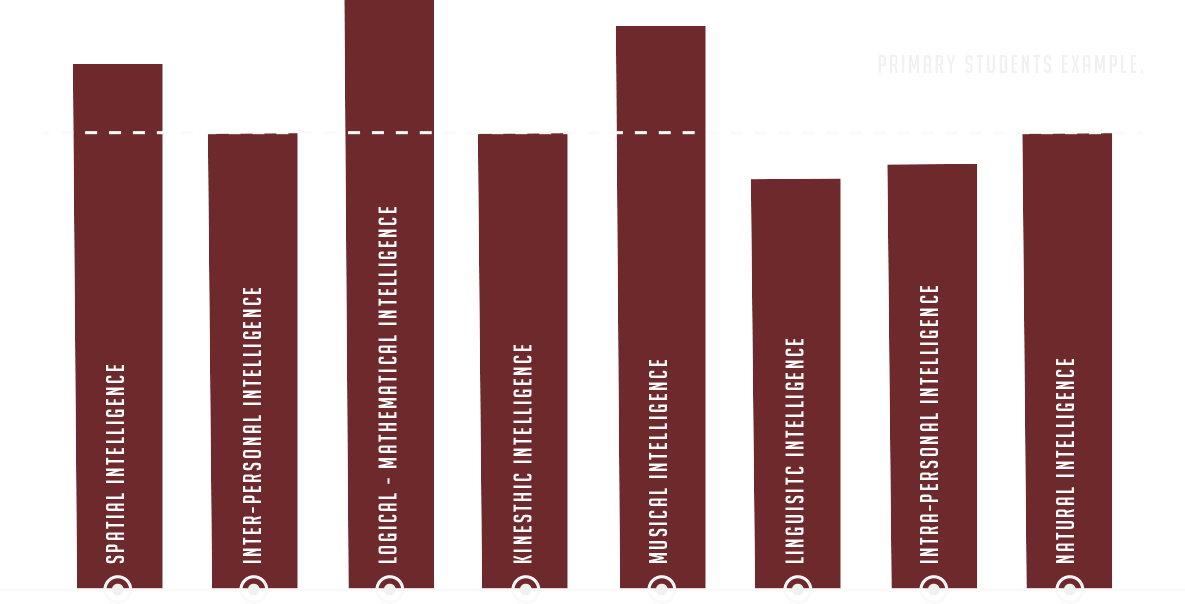
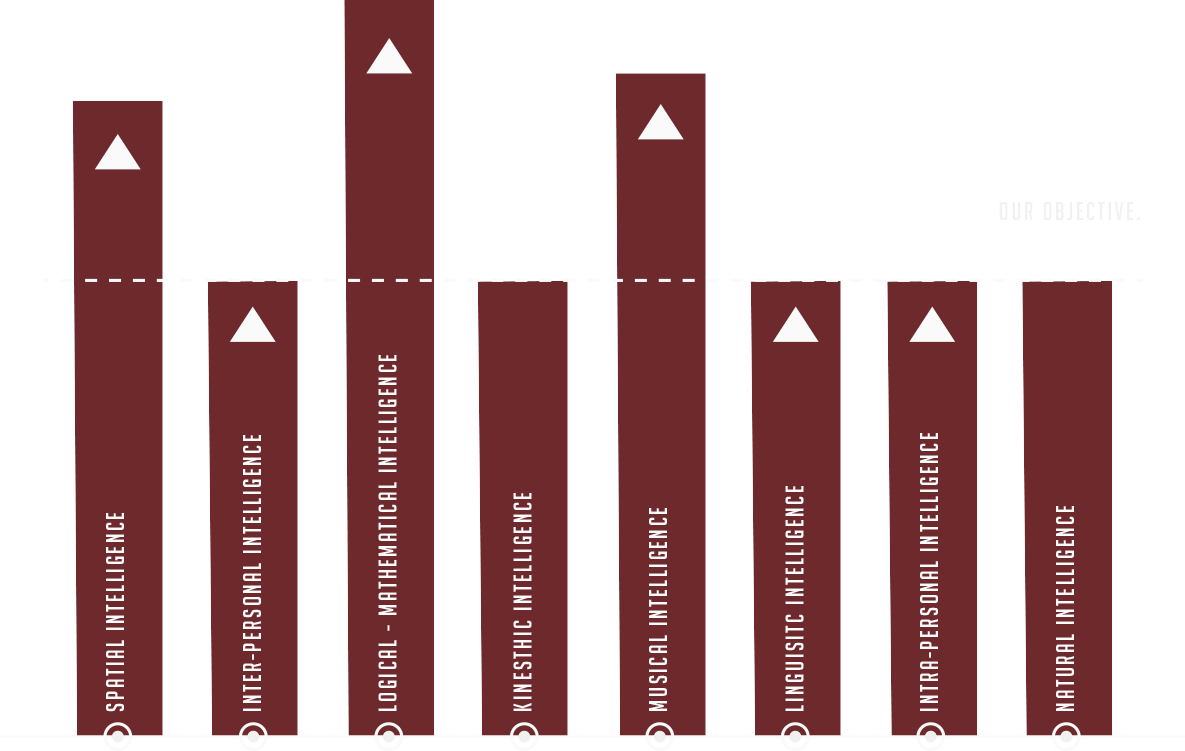
We should not ignore the fact that, although there is still much debate surrounding the topic, certain types of intelligences are best developed at certain ages. This is the case for linguistic intelligence (language learning), mathematical intelligence, interpersonal intelligence, and intrapersonal intelligence in which, after a certain age, one begins to encunter difficulties in learning new information. Although it is never too late, the earlier one starts, the better the result will be. Whichever innate intelligences a child may possess, it is our job at True Horizon to identify them at the earliest age possible to be able to stimulate their most noteworthy abilities and strengthen their greatest weaknesses.